
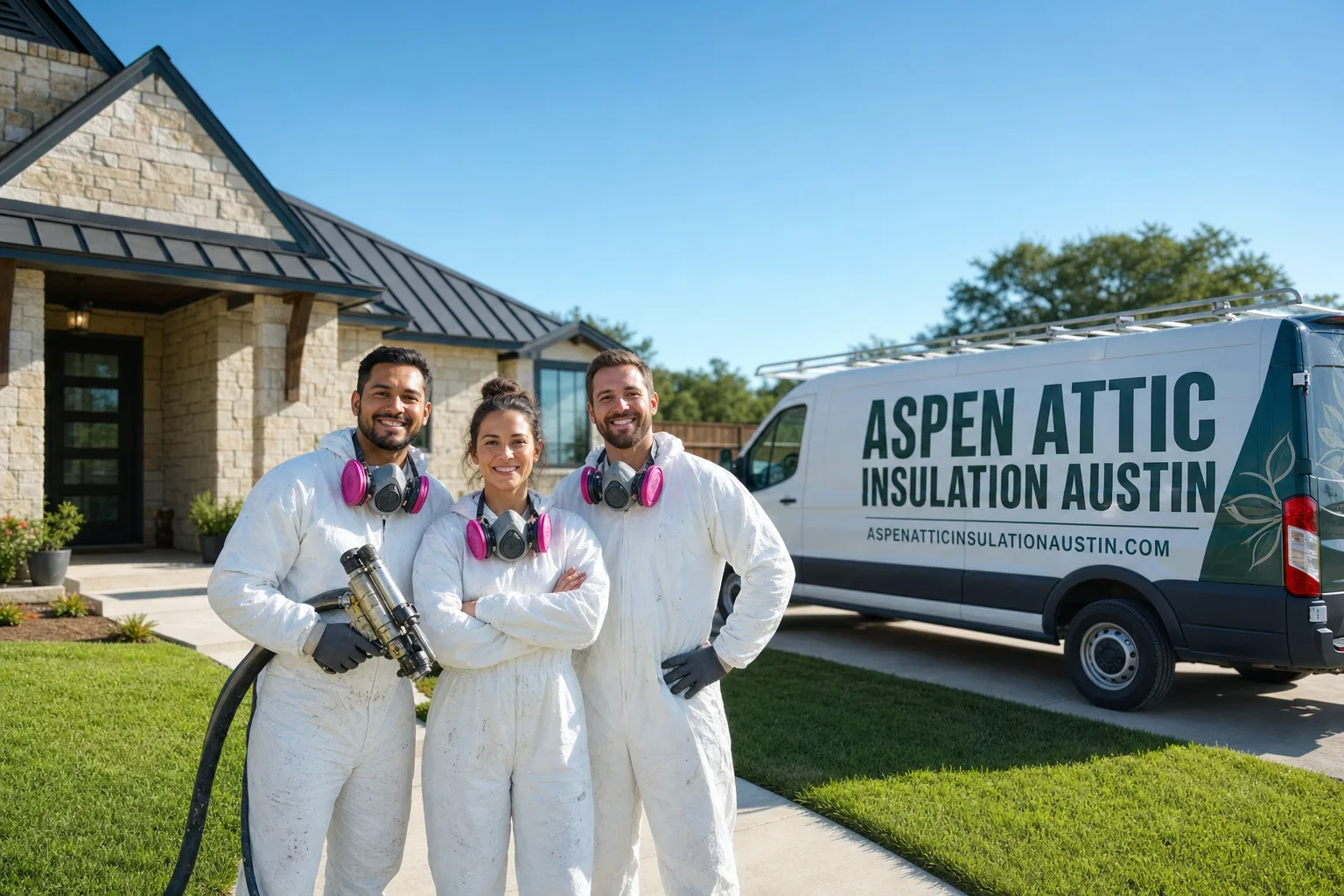
Trusted Spray Foam Insulation for Austin Homeowners
If you’re wondering how much Spray Foam Insulation costs, Austin prices typically run $1.50 to $4.50 per board foot installed, and most whole-attic projects fall between $3,500 and $9,800 depending on foam type, square footage, and access. Aspen Attic Insulation Austin has been insulating homes across Travis County since 2002, and we answer the phone 24/7 with a live person, never a voicemail loop. When you call (325) 246-2929, you’ll get a written price before any work starts, plus the name and photo of the technician who will show up at your door. That’s how Garrett Sloane runs every job we take in Austin.
Austin summers punish under-insulated homes. Attics here routinely hit 140°F in August, and that heat pushes down into living spaces, making your AC run twice as hard. Closed-cell foam blocks that heat transfer at the source. We also see plenty of homes in Jollyville, Wells Branch, and Lost Creek with fiberglass batts that were installed decades ago and have settled into uselessness. Spray foam doesn’t settle. It doesn’t sag. It seals.
Closed Cell Spray Foam Insulation
Closed Cell Spray Foam Insulation is a dense, rigid foam that adds structural strength and acts as a moisture barrier, making it the right choice for Austin homes with humidity concerns, metal buildings, or areas prone to flooding. Aspen Attic Insulation Austin installs closed-cell foam in attics, walls, crawl spaces, and rim joists, and we typically price it between $2.50 and $4.50 per board foot. In neighborhoods like Shady Hollow and Brushy Creek, where homes sit close to creeks and greenbelts, closed-cell is our most requested option because it doesn’t absorb water.
Structural Reinforcement
Closed-cell foam hardens to roughly the consistency of a firm yoga mat. It bonds to the framing and adds racking strength to walls, which matters in older pier-and-beam homes around East Austin. If your home predates the 1980s, this added rigidity is worth considering.
Vapor Barrier Performance
At 2 inches thick, closed-cell foam creates an impermeable vapor seal. For crawl spaces in Camp Swift or Elgin, where ground moisture seeps up through the dirt, that seal keeps humidity from migrating into floor joists and subflooring. It also means you can skip a separate plastic vapor barrier in most applications.
Open Cell Spray Foam
Open Cell Spray Foam is a softer, sponge-like foam that expands up to 100 times its liquid volume, filling every crack and cavity in an attic or wall cavity, and it’s the more budget-friendly option at $1.50 to $2.50 per board foot. Aspen Attic Insulation Austin recommends open-cell foam for attic roof decks and interior walls where sound control and air sealing matter more than moisture resistance. In Austin’s dry climate, open-cell performs well in vented attics where airflow is already managed.
Air Sealing First
Open-cell foam’s biggest job is stopping air movement. It fills gaps around recessed lights, duct chases, and top plates that fiberglass simply can’t seal. Homeowners in Hornsby Bend and Lockhart who switch from batts to open-cell typically see their cooling bills drop within the first full month.
Sound Dampening
Because open-cell foam stays soft after curing, it absorbs sound instead of reflecting it. We install it in interior bedroom walls and home offices across Austin where street noise from I-35 or Mopac bleeds through the framing. It makes a noticeable difference in older homes with thin drywall.
Spray Foam Insulation Contractors
Spray Foam Insulation Contractors are licensed, trained professionals who apply two-part chemical foam with specialized equipment, and Aspen Attic Insulation Austin has been doing exactly that since 2002 under the Threshold Standard, which means every technician is background-checked, identity-verified, and photo-badged before they ever step onto your property. You’ll know your contractor’s name and face before the van pulls up. If anyone else arrives, the visit is free and we make it right.
The Threshold Standard
Every Aspen tech goes through the same verification process before they’re cleared for Austin jobs. Background check, identity verification, uniform issuance, and photo badging are non-negotiable. Garrett Sloane personally reviews every tech file before a new hire runs routes solo.
Two-Part Chemistry
The foam we spray is created on-site by mixing an isocyanate and a polyol resin at high pressure. Getting the mix ratio right matters: too much of either component and the foam never cures properly. Our crews calibrate the equipment at the start of every job and test-spray a sample before touching your walls.
Spray Foam Attic Insulation
Spray Foam Attic Insulation is the application of foam to the underside of the roof deck, turning your attic into a sealed, conditioned space rather than a 140-degree oven, and it typically runs $3,800 to $8,500 for a full attic in Austin. Aspen Attic Insulation Austin has insulated hundreds of attics in Round Rock and Cedar Park, and we always provide a written price before any foam leaves the truck. This is our most requested service in the Austin metro.
Hot Roof Decks
In an unvented attic, closed-cell foam applied to the roof deck keeps heat from ever entering the attic in the first place. That means your ductwork, which probably runs through the attic, isn’t sitting in superheated air. Homes in Wells Branch with attic-mounted HVAC systems see the biggest comfort gains from this approach.
Ductwork Protection
When your ducts sit in a sealed, conditioned attic, they don’t sweat in summer or freeze in winter. That reduces the condensation that leads to mold growth on duct insulation. If you’ve got flex ducts running through a sweltering attic in Brushy Creek, spray foam solves the root problem instead of patching the symptom.
Spray Foam Wall Insulation
Spray Foam Wall Insulation is foam applied inside exterior wall cavities during construction or renovation, creating a continuous air and thermal barrier from the bottom plate to the top plate, and it costs about $2 to $3.75 per board foot in Austin depending on whether you choose open or closed cell. Aspen Attic Insulation Austin handles both new construction and retrofit wall insulation, including injection foam for existing walls in older Austin neighborhoods.
Retrofit Wall Injection
For existing homes, we drill small access holes and inject foam directly into wall cavities. This works especially well in 1950s and 1960s ranch homes around Jollyville and Lost Creek where the original insulation has compacted to almost nothing. The holes get patched and painted, and your walls finally stop leaking conditioned air.
New Construction Prep
Builders and homeowners in the early framing stages call us before the drywall goes up. We spray open-cell foam into the stud bays, which fills every electrical box and plumbing penetration gap. The result is a wall assembly that performs dramatically better than fiberglass batts, and the framing inspection passes with no issues.
Rim Joist Spray Foam
Rim Joist Spray Foam is the application of closed-cell foam to the band board where your floor framing meets the foundation wall, a spot that leaks air and lets bugs in, and it’s one of the most cost-effective insulation upgrades you can make, typically running $900 to $2,200 for a full perimeter in Austin. Aspen Attic Insulation Austin treats rim joists in crawl spaces and basements throughout Travis County, and we use closed-cell foam exclusively because it needs to resist moisture in that location.
The Air Leak Nobody Sees
The rim joist is where your house frame sits on the foundation, and it’s almost never insulated well. In older homes around Elgin and Lockhart, you can often see daylight through gaps at the rim joist. Sealing and insulating that band with closed-cell foam stops the stack effect that pulls hot attic air in and pushes cooled air out.
Pest Barrier Bonus
Closed-cell foam is too dense for rodents to chew through, and it seals the tiny gaps that ants and roaches use to enter a house. In Austin’s climate, where termites and fire ants are constant pressure, a sealed rim joist is one less entry point. We’ve had customers tell us their pest control bills dropped after we foamed their rim joists.
Crawl Space Spray Foam Insulation
Crawl Space Spray Foam Insulation is the application of closed-cell foam to crawl space walls and rim joists, converting a damp, drafty under-floor area into a clean, sealed buffer zone, and it typically costs $2,800 to $6,500 depending on crawl space size and access in Austin. Aspen Attic Insulation Austin sprays foam on foundation walls rather than between floor joists, because insulating the walls brings the crawl space into the home’s thermal envelope. That’s the current best practice, and it’s how we do every crawl space job.
Wall Insulation Over Floor Insulation
Insulating between floor joists leaves the crawl space itself cold and damp, which means your floors still feel chilly in winter. Foaming the crawl space walls instead keeps the entire under-floor area warmer and drier. Homes in Shady Hollow and Camp Swift with pier-and-beam foundations benefit most from this approach.
Moisture Control
Closed-cell foam acts as both insulation and vapor barrier on crawl space walls. In Austin’s humid spring months, that means less moisture migrating up into your floor structure. We recommend pairing crawl space foam with a ground vapor barrier for the best results, and we’ll tell you whether you need both before any work is quoted.
Garage Spray Foam Insulation
Garage Spray Foam Insulation is the application of foam to the garage ceiling, walls, or the shared wall between the garage and living space, and it’s a popular upgrade for Austin homeowners who use their garage as a workshop, gym, or bonus room, typically running $1,800 to $4,200 depending on scope. Aspen Attic Insulation Austin sprays garage ceilings with open-cell foam to keep the space tolerable in summer, and we do shared-wall insulation to keep garage heat from bleeding into your kitchen or bedroom.
Ceiling Treatment First
Most Austin garages have zero insulation above them. The roof deck absorbs sun all day, and that heat pours down into the garage. Foaming the garage ceiling with open-cell foam drops the temperature by 15 to 25 degrees in summer, which is the difference between a usable space and a storage oven.
Shared Wall Sealing
If your garage shares a wall with a bedroom or living room, that wall needs air sealing and insulation. Exhaust fumes, paint smells, and heat from the garage migrate through gaps around outlets and framing. Closed-cell foam on that shared wall blocks both air and vapor, and it’s a relatively small job that makes a big difference in indoor air quality.
Brands We Service
We install and service spray foam from Demilec, a manufacturer that’s been producing closed-cell and open-cell foam for decades, and their products perform exceptionally well in Austin’s high-heat attics. We also work extensively with Icynene open-cell foam, which is a favorite for sound-dampening interior walls and garage ceilings. For projects that call for a hybrid approach, we stock Owens Corning fiberglass to complement spray foam applications, giving you the right material for each part of the house rather than forcing one product everywhere.
Whether you have Demilec, Icynene, Owens Corning, Johns Manville, or any other brand in place, we can assess it, repair it, or replace it. Our crews are trained on eight industry-leading material lines, and we match the product to the problem: closed-cell for moisture-prone areas, open-cell for sound and air sealing, fiberglass for budget-conscious fill work. You’ll never get a one-size-fits-all answer from Aspen Attic Insulation Austin because one size doesn’t fit any house.
Signs You Need a Pro Right Now
- Your upstairs rooms stay hot no matter how low you set the AC. This usually means your attic insulation has failed or was never adequate. Heat from the roof deck is pushing down through the ceiling, and your AC is fighting a losing battle. Spray foam on the roof deck stops the heat before it enters the attic at all.
- You can see daylight through gaps around pipes or wires in the attic floor. Gaps like these let conditioned air escape into the attic and pull hot outside air in. Every gap is a dollar sign on your electric bill, and foam is the only insulation that actually seals them shut.
- Your energy bills spike every summer and never really recover. Austin’s cooling season runs from May through October, and if your bills keep climbing while your usage stays the same, you’re losing conditioned air somewhere. Insulation is almost always the culprit, and you can see it in the bill trends.
- You find mouse droppings or roach trails in the attic or crawl space. Rodents and insects enter through rim joist gaps and attic vents that fiberglass doesn’t block. Closed-cell foam is dense enough to stop most pests, and it seals the entry points they use. If you see signs of pests, the entry points are already there.
- Your floors feel cold in winter even with the heat running. Cold floors typically mean your crawl space or rim joist is uninsulated and leaking air. Foaming the crawl space walls brings the under-floor area into the conditioned envelope, and your floors stop feeling like ice.
Our Process, Step by Step
- 1
You call (325) 246-2929 and talk to a live person. No phone trees, no voicemail, no call-back windows. We take your information, ask about the space you want insulated, and schedule a visit at a time that works for you. You’ll know who’s coming before they arrive because we send the tech’s name and photo in advance.
- 2
The tech arrives in a marked uniform with a photo ID badge. Our technician introduces themselves at the door, shows their badge, and walks the space with you. They’ll check the attic, crawl space, rim joists, or wherever the problem is, using an infrared thermometer and moisture meter to find air leaks and problem areas you can’t see from the outside.
- 3
You get a written price before any work starts. No verbal estimate, no vague ranges, no surprise invoices. The written quote covers labor, materials, and cleanup, and it’s the exact number you’ll pay. If the job requires more work than expected, we stop and get your sign-off before continuing. That’s the Aspen Attic Insulation Austin rule, and it’s been in place since 2002.
- 4
We do the work and clean up after ourselves. The foam gets sprayed, the equipment gets packed out, and your space is left clean. We check the foam thickness against the spec from the manufacturer, and we photograph the finished work so you have a record of what was installed and where.
- 5
You receive the 365-Day Done Right Promise in writing. If anything isn’t done right, we make it right, and that guarantee covers labor and materials for a full year. If a repair fails during that year, your second visit is free. No fine print, no prorated nonsense.
How Much Does Spray Foam Insulation Cost in Austin?
A typical open-cell attic spray foam job in Austin runs $3,800 to $6,500, while a closed-cell attic usually lands between $6,000 and $9,800. Rim joist sealing averages $900 to $2,200, and garage ceiling foam runs about $1,800 to $3,600 depending on square footage. Wall cavity foam during new construction costs $2 to $3.75 per board foot, and crawl space wall foam typically totals $2,800 to $6,500. These are real ranges from real Austin jobs, not national averages that don’t reflect our market.
What affects the price: foam type (closed-cell costs roughly 60% more than open-cell), square footage, access difficulty, and whether we’re removing old insulation first. How to avoid overpaying: get a written line-item quote, make sure the contractor specifies foam thickness in inches, and verify the brand being used. Your free estimate from Aspen Attic Insulation Austin includes a full walkthrough, moisture readings, and a written price you can hold in your hand before you decide anything. Call (325) 246-2929 to schedule yours.
Our Service Area Near Austin
Aspen Attic Insulation Austin serves the entire Austin metro. We’re in Round Rock, Cedar Park, Jollyville, Brushy Creek, and Wells Branch most days, and we regularly run crews to Lockhart, Elgin, Camp Swift, Hornsby Bend, Lost Creek, and Shady Hollow. Typical response time is same-day or next-day for most Austin neighborhoods, and our home service area page has the full map. For spray foam work in the northern suburbs, see our Spray Foam Insulation in Round Rock and Spray Foam Insulation in Cedar Park pages for local specifics.
Serving Austin, TX - Our Local Coverage Area
We’re based in the Austin area and know this community well. Use the map below to see our service coverage - if you’re nearby, we can almost certainly help.
Frequently Asked Questions About Spray Foam Insulation in Austin
Spray foam insulation is a two-part chemical mixture that expands on contact and hardens into a solid foam that seals air gaps and insulates in one step. It’s applied with specialized equipment that heats and pressurizes the two components, then sprays them together at the nozzle. Unlike fiberglass batts, spray foam fills every crack and void, creating a continuous air barrier that stops heat transfer and air leakage.
Most attics in Austin take one full day to foam, and the foam cures within 24 hours, after which it’s safe to be around. Rim joist jobs and garage ceilings often finish in half a day. We’ll give you a specific timeline with your written estimate so you know exactly how long we’ll be in your home.
Open-cell spray foam runs $1.50 to $2.50 per board foot, and closed-cell runs $2.50 to $4.50 per board foot, with whole-attic projects ranging from $3,800 to $9,800. The total depends on foam type, square footage, and access. Call (325) 246-2929 for an exact quote, and it’s free, with the price in writing before any work begins.
Yes, we’re trained on both Demilec and Icynene spray foam systems, and we stock their products for installations and repairs. We also work with Owens Corning and Johns Manville materials for hybrid applications. If you have an existing foam installation from any major manufacturer, we can assess it and tell you whether it needs repair or replacement.
We answer the phone 24/7, and in most Austin neighborhoods we can get a technician to your home the same day you call. If you’ve had a roof leak that soaked your attic insulation, or you’ve discovered a pest infestation in your rim joists, call (325) 246-2929 and we’ll get someone out. The initial assessment is free, and you’ll have a written price before any work starts.
The 365-Day Done Right Promise covers labor and materials on every spray foam job for a full year from the installation date. If anything fails during that year, your second visit is free. It’s a written guarantee, not a verbal assurance, and it’s included on every job we do in Austin, no exceptions.
We ask that you clear a path to the attic access or crawl space entry, move any stored items away from the work area, and keep pets and children out of the rooms directly below the workspace during installation. We handle everything else: floor protection, ventilation, and cleanup. If you have questions about a specific room or item, ask us when you call and we’ll tell you exactly what to do.
Schedule Your Spray Foam Insulation Service in Austin Today
Call (325) 246-2929 and you’ll speak to a live person who can schedule your free estimate right away. You’ll get a written price before any work starts, a technician whose name and photo you’ll know in advance, and a 365-day guarantee in writing. No pressure, no surprises, no strangers at your door. That’s how Garrett Sloane and the Aspen Attic Insulation Austin team have worked since 2002.
Written by Garrett Sloane, Owner at Aspen Attic Insulation Austin, serving Austin since 2002.