
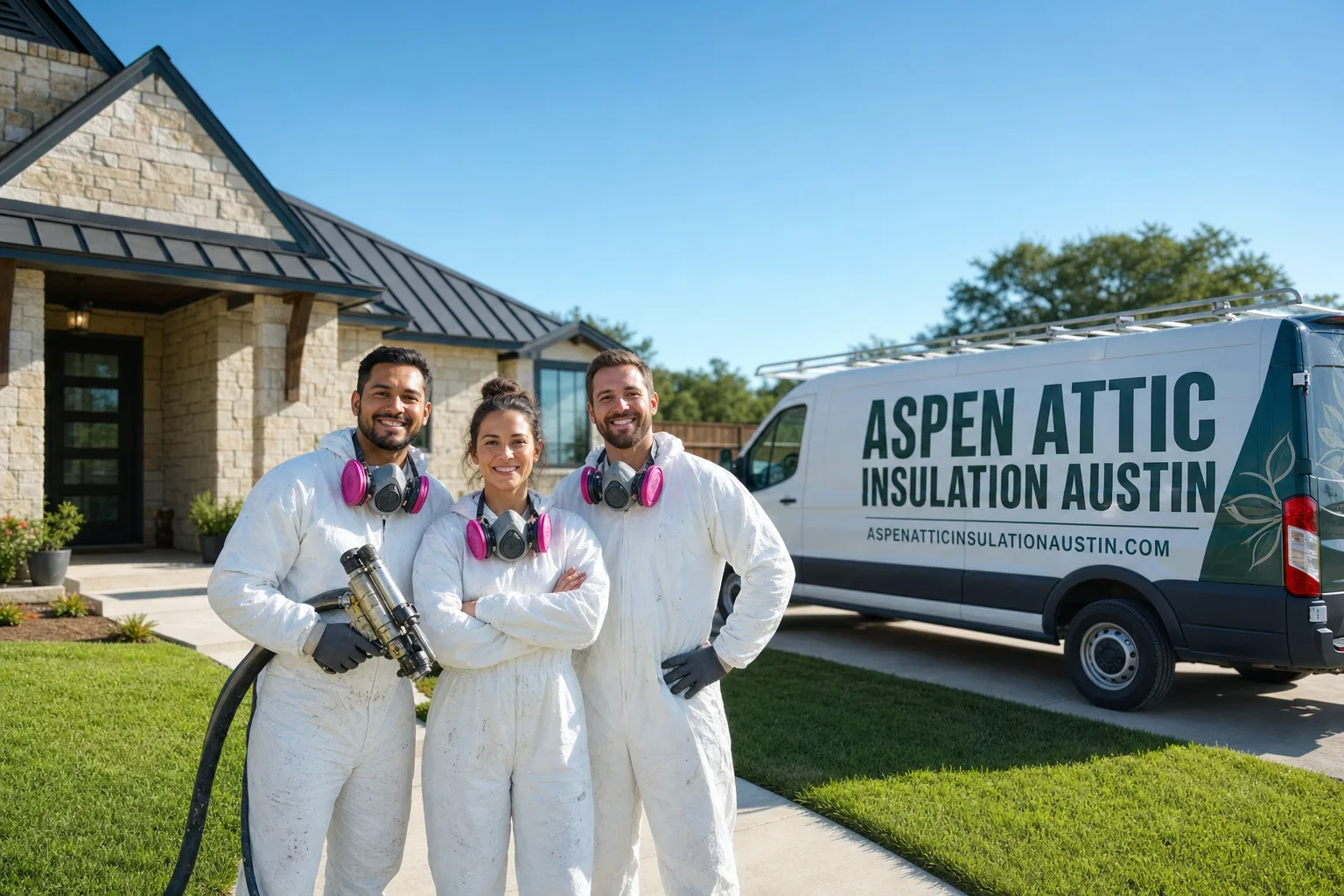
Fast, Reliable Blown In Insulation Across Elgin
Blown-in insulation in Elgin typically costs $1,800 to $4,200 for an attic of 1,200 to 1,800 square feet, and most jobs are completed in a single day. If your home swings hot in summer and cold in winter, or the AC never seems to shut off during a 98-degree afternoon, your attic or walls are likely under-insulated. We serve every corner of Elgin, from the historic downtown district to the newer subdivisions off Highway 290, and our techs arrive with a written price before any work starts. Call (325) 246-2929 for a free estimate.
Why Aspen Attic Insulation Austin Is Elgin’s Preferred Blown In Insulation Company
Our Blown In Insulation team has worked in enough Elgin homes to know what’s behind the walls. Many houses near the railroad tracks and along Main Street were framed with true 2×4 lumber and built before central air was a given, so attics often hold a thin layer of settled fiberglass and wall cavities sit completely empty. That’s not a generic problem; it’s a specific Elgin pattern we plan for on almost every older-home job.
Garrett Sloane runs our crews, and the standard he holds is simple: the homeowner knows who is pulling up to the curb before we ever knock. Every technician who works in Elgin is background-checked, identity-verified, and arrives in a marked uniform with a photo ID badge. We send the tech’s name and photo ahead of the visit. If someone else shows up at your door, the visit is free and we make it right. That standard is called the Threshold Verified protocol, and it applies to every single Elgin visit.
We also stock materials matched to Elgin’s housing mix. Fiberglass, cellulose, and spray foam each suit different situations here, and we carry product from Owens Corning, Johns Manville, and GreenFiber so older brick cottages and newer suburban builds get the right product rather than whatever happens to be on the truck.
Blown In Insulation Contractors in Elgin
Blown In Insulation Contractors in Elgin handle loose-fiber material that is blown under pressure into attic floors, wall cavities, and knee walls to fill gaps and create a continuous thermal barrier. In Elgin, this matters most in homes built before 1980, where settled insulation and uninsulated wall cavities mean cooling dollars leak out all afternoon. A typical attic retrofit in Elgin runs $1,800 to $3,400, depending on square footage and current R-value. Wall cavity retrofits, especially on brick-veneer homes, add to that range.
The physical work involves drilling access points, running a hose to the blower unit, and filling the cavity evenly at the correct density. In Elgin’s older homes, layout matters. Attics with shallow clearances and tight alley access need a technician who knows where the soffit vents sit and how to avoid blocking them, otherwise the whole assembly loses airflow and starts holding moisture.
Attic Retrofits on Elgin Ranch Homes
Elgin has hundreds of 1950s and 1960s ranch-style homes with shallow-pitch roofs and tight attic access through small interior hatches. Getting a blower hose into and through those spaces takes planning, and the work matters because the existing insulation in these attics is typically compressed or blown around by years of attic traffic. We check that before adding anything new.
Most ranch attics that come our way need a full top-up and air sealing around penetrations. Recessed lights, plumbing stacks, and old vent boots all leak conditioned air into the attic, and no amount of additional fiberglass fixes that. Our techs seal first, then blow to the correct depth.
Wall Cavity Work on Brick-Veneer Cottages
In Elgin’s historic downtown, brick veneer sits over wood framing that often has no insulation at all. Blowing cellulose or fiberglass into those cavities means drilling small exterior access holes through mortar joints, not through brick faces. That technique preserves the facade and avoids the moisture traps that occur when someone drills directly through brick and leaves the hole unsealed.
Each cavity gets measured, filled to the right density, and the access holes are patched and color-matched. That work takes a day or less on a typical cottage, and because we do it regularly in Elgin, we know which mortar mixes and patch materials blend with the older brick tones found downtown.
Cellulose Insulation in Elgin
Cellulose Insulation in Elgin is the material we recommend for most wall cavity retrofits on older brick-veneer homes, and for many attic top-ups when the homeowner wants a denser, air-resisting product. Cellulose is made from recycled paper treated with borate for fire and pest resistance. In Elgin’s humid climate, it performs well when installed at the right density, and it settles less than loose fiberglass when properly blown. A cellulose attic top-up in Elgin typically runs $2,000 to $3,800 depending on depth and square footage.
Cellulose can be blown into a wall cavity through the same small access holes used for fiberglass, but it fills irregular old framing better. That matters in Elgin’s historic district, where stud bays are rarely the clean, consistent dimensions you find in newer construction. The material packs into gaps and odd corners without leaving the voids that can happen with batts or even fiberglass in older framing.
Dense-Pack Cellulose for Uninsulated Walls
Dense-packing is the standard for wall retrofits in Elgin’s pre-1950s homes. The material is installed under higher pressure to fill the cavity fully, which improves air sealing and resists settling. That’s the difference between a wall that performs and one that leaves the top six inches of every stud bay empty.
We dense-pack most downtown Elgin wall cavities, particularly where the original wood-framed walls remain open to the exterior sheathing. The technique works well on brick-veneer homes because the access points are small and the material conforms to the existing framing.
Attic Top-Ups for Humid Summers
Cellulose in an Elgin attic should be blown over existing insulation only when that existing material is dry, settled, and free of mold or rodent damage. If pest activity or past roof leaks have contaminated the old fiberglass, removal comes first. We check for that before adding anything. In the humid Elgin summers, a vented attic with proper airflow keeps cellulose performing well, so we verify soffit and ridge vent function as part of every top-up.
Trusted Brands We Service in Elgin
We install and maintain blown-in insulation from Owens Corning, Johns Manville, and GreenFiber, and we stock those materials locally for Elgin jobs. That means faster turnarounds and no waiting on a warehouse in another city. Whether you need dense-pack cellulose or a standard fiberglass attic top-up, the product we quote is the product that goes in, matched to your home’s construction. Our techs also service and supplement existing insulation from other manufacturers, and we’ll tell you honestly if an existing installation is worth keeping or should be pulled and replaced.
Common Blown In Insulation Problems We See in Elgin Homes
- Moisture trapped in brick-veneer walls. Blown-in insulation installed without a proper vapor strategy in Elgin’s humid climate can trap condensation inside the wall cavity. That leads to mold, musty smells, and deteriorated mortar joints, which we frequently find when called out to inspect older brick cottages.
- Settled cellulose leaving hot spots near ceiling edges. In older ranch homes with shallow attic clearances, insulation that has settled over decades leaves the top portions of exterior walls uninsulated. Homeowners notice warm bands along ceiling edges, especially in afternoon heat.
- Insulation blown too close to old wiring. Elgin homes still have knob-and-tube wiring in some attics and walls. Blowing insulation directly over or around this wiring can cause it to overheat. Our techs keep prescribed clearance around electrical boxes and old circuits, and we flag any wiring that needs an electrician’s attention before insulation goes in.
- Blocked soffit vents from careless blowing. Tight, alley-access attics in Elgin make it tempting for installers to skip checking vent paths. When soffit vents get buried, attic temperatures climb and humidity stays trapped. That shortens roof life and pushes cooling costs up.
Pricing for Blown In Insulation in Elgin, TX
Blown-in insulation in Elgin runs $1,800 to $4,200 for most attic jobs on homes under 2,000 square feet. Wall cavity retrofits on brick-veneer homes typically add $1,500 to $3,500 depending on accessible wall area and framing quirks. A full dense-pack wall job plus attic top-up on a historic downtown cottage often lands between $4,000 and $7,000. Square footage, current R-value, access difficulty, and whether existing insulation needs removal drive the final number.
Every Elgin job gets a written price before work begins. No post-work surprises, no “while we were up there” additions. That price covers labor and materials, and it’s backed in writing for the full scope we quoted. Call (325) 246-2929 and we’ll walk your home, take measurements, and give you a number you can hold us to.
We Also Serve Cities Near Elgin
Our crews work regularly in Elgin and the surrounding Central Texas communities. You’ll find us in Round Rock, Austin, Cedar Park, and Buda, often on the same day a call comes in. If you’re just outside Elgin proper, call (325) 246-2929 and we’ll confirm coverage for your street.
Serving Elgin, TX - Our Local Coverage Area
We’re based in the Elgin area and know this community well. Use the map below to see our service coverage - if you’re nearby, we can almost certainly help.
FAQs About Blown In Insulation in Elgin
Yes, blown-in insulation can be added to Elgin’s brick-veneer homes by drilling small access holes through the mortar joints, not the brick faces. The key is using the right density and an appropriate vapor strategy for Central Texas humidity. We patch every access hole with a color-matched mortar. Any installer who skips the moisture calculation or drills through brick faces is setting up mold problems, and you’ll pay for that later. Call (325) 246-2929 and we’ll inspect your walls before quoting.
Dense-pack cellulose works best for Elgin’s historic downtown homes with uninsulated wood-framed walls. It fills irregular old stud bays, resists settling, and air-seals as it’s installed. Fiberglass can work in newer framed walls, but our default recommendation for pre-1950s Elgin construction is cellulose. We’ll confirm that after looking inside your walls. Estimates are free.
We access Elgin attics through the existing interior hatch, garage scuttle, or, in a few downtown homes, a gable vent with added protection so nothing gets damaged. In alley-load and tightly spaced homes, we run the blower hose through the shortest clear path and work section by section, checking soffit vents and wall top plates for gaps before we finish. Coverage is verified with a depth gauge. If we cannot reach a section safely, we will tell you that before quoting, not after starting.
Yes, blown-in insulation reduces cooling costs in Elgin, often by 15 to 30 percent on older under-insulated homes, because the AC stops working against a superheated attic and bare wall cavities. The bigger change most of our Elgin customers notice is comfort: rooms hold temperature instead of swinging 10 or 15 degrees between morning and afternoon. For a free estimate and honest numbers, call (325) 246-2929.
Blown-in insulation can be installed over existing settled fiberglass as long as that existing material is dry, clean, and free of mold or rodent contamination. In Elgin ranch attics, we check for moisture staining, animal droppings, and old wiring before deciding. If the existing fiberglass is in decent shape, we blow right over it. If not, removal comes first, and we’ll show you what we found. Call (325) 246-2929 to schedule an attic inspection.
In Elgin’s historic downtown, many homes have original wood-framed walls with no insulation at all. Adding blown-in insulation through small exterior holes is the only way to preserve the brick facade while improving energy efficiency. On a brick cottage just off Main Street, our crew drilled 2-inch access holes through the mortar joints and blew GreenFiber cellulose into the uninsulated wall cavities, avoiding the brick veneer entirely while bringing the R-value from near zero to R-13. The homeowner later reported that the front rooms stopped swinging 20 degrees between morning and afternoon, and the window unit no longer ran constantly during the 98-degree afternoons.
Written by Garrett Sloane, Owner at Aspen Attic Insulation Austin, part of the Threshold Group family since 2002.