
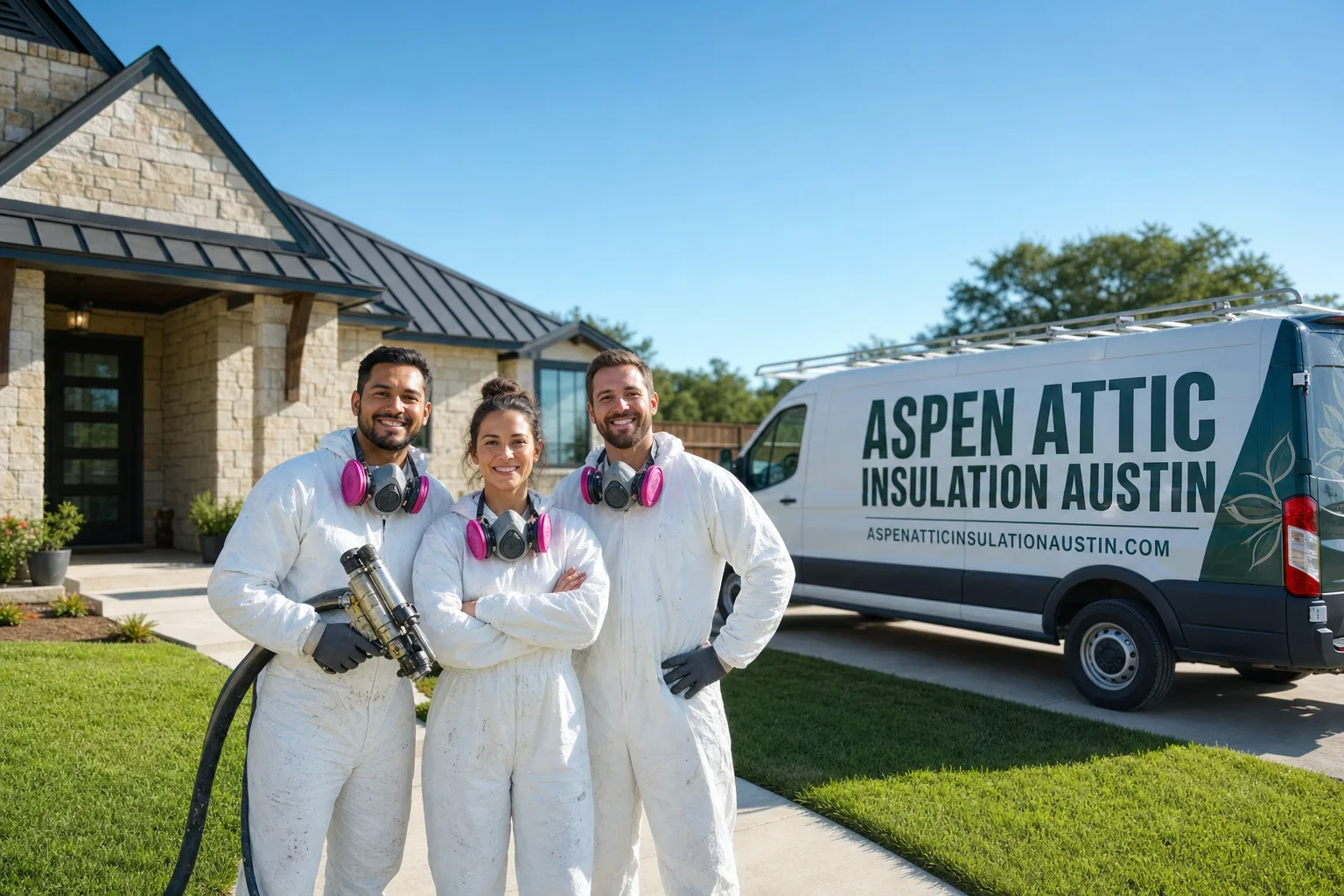
Fast, Reliable Blown In Insulation Across Round Rock
Blown in insulation in Round Rock typically costs $1,400 to $3,800 for an average 1,500 – 2,200 square foot attic, and most jobs wrap up in a single day. That’s the honest range homeowners in Forest Creek, Stone Canyon, and Teravista can expect. We’re Aspen Attic Insulation Austin, and our crews are in Round Rock neighborhoods every week. Scheduling is coordinated from our Austin office, but the technicians who arrive at your door are local to this area and know Round Rock homes. Call (325) 246-2929 for a free estimate, and you’ll have a written price before any work begins.
Why Aspen Attic Insulation Austin Is Round Rock’s Preferred Blown In Insulation Company
Round Rock homeowners have a particular kind of attic problem, and we’ve spent years understanding it. Homes built here during the 1990s and early 2000s boom were insulated to a code that hasn’t aged well. The 1993 energy standard allowed fiberglass batt installation that now sits settled, compressed, and far below what Central Texas heat demands. When our technicians walk a Round Rock attic, they carry an insulation depth gauge and check what’s actually there, not what the builder claimed in 1998.
Every technician who shows up at a Round Rock door is background-checked, identity-verified, and sent to you by name and photo before the visit. That’s the Round Rock local experience we’ve built: a live person answers the phone 24/7, and the person in the marked uniform holding the photo ID badge is the same person whose name you already know. Garrett Sloane leads our crews, and he holds the Threshold Standard as non-negotiable: clean tools, clear communication, and a written 365-Day Done Right Promise on every job.
Our reputation in Round Rock comes from not cutting corners on materials or people. We run Owens Corning, Johns Manville, and GreenFiber products daily, but the bigger differentiator is what happens before work starts: you get a written price. No post-job calls explaining why the bill changed. That’s why Round Rock homeowners keep our number saved when their upstairs bedrooms won’t cool below 80°F in July.
Blown In Attic Insulation in Round Rock
Blown In Attic Insulation in Round Rock means loose fiberglass or cellulose fibers blown into the attic cavity at specified depths to fill every gap, seam, and void that batt insulation left open. For Round Rock homes built from the 1980s through the early 2000s, this is rarely a luxury upgrade. It’s a corrective measure. Builders in that era met minimums that now fall far short of the R-38 to R-60 recommended for Central Texas attic assemblies. Our Blown In Insulation team measures existing depth, identifies thermal bypasses, and calculates exactly how much additional material your attic needs to hit target R-value.
Air Sealing Before the Blow
Most Round Rock attics have gaps around can lights, plumbing chases, and top plates where conditioned air escapes continuously. We seal these bypasses before blowing insulation. Skipping this step wastes material and leaves the home leaking air regardless of insulation depth. The result matters: sealed homes hold temperature better and run HVAC systems less.
What It Costs
Blown in attic insulation in Round Rock runs $1,400 to $3,800 depending on square footage, access difficulty, and whether old material needs removal first. Older homes with vermiculite or rodent-damaged insulation add haul-away costs. You’ll know the exact number before we start, in writing.
Blown In Cellulose Insulation in Round Rock
Blown In Cellulose Insulation in Round Rock uses treated recycled paper fibers, typically GreenFiber, blown dense into attic floors or wall cavities. For Round Rock homeowners, cellulose offers a real advantage in our khumid summers: its higher density slows air movement and adds measurable sound dampening between floors. That matters in two-story homes in neighborhoods like Forest Creek and Sendero Springs, where upstairs bedrooms sit directly under a hot attic and foot traffic noise travels.
Cellulose for Retrofit Walls
When Round Rock homes built before 2000 have wall cavities that were never insulated or have settled batts, blown-in cellulose is often the most practical retrofit. Small access holes are drilled, material is dense-packed, and the holes are patched. This addresses the winter condensation problem that shows up as damp spots behind brick veneer or HardiePlank in older Round Rock sections.
Cellulose vs. Fiberglass in Practice
Cellulose costs slightly more per square foot than fiberglass but can deliver tighter air-sealing performance in old, leaky cavities. The price difference in Round Rock is typically $0.30 to $0.60 per square foot installed. We’ll recommend based on your attic’s condition and your home’s specific heat-gain profile, not a default product list.
Trusted Brands We Service in Round Rock
We install and service insulation from Owens Corning, Johns Manville, Knauf, and GreenFiber, and we stock high-demand materials for Round Rock jobs so you’re not waiting on a warehouse delivery across town. For 1990s attics with settled fiberglass, we often spec Owens Corning AttiCat blown-in fiberglass to reach R-49 cleanly over existing batts. When dense-pack wall work is called for, GreenFiber cellulose is the go-to. The brand is matched to your attic’s ventilation style, access points, and moisture profile. That’s what happens when the installer carries eight industry-leading brands instead of pushing one product on every house.
Common Blown In Insulation Problems We See in Round Rock Homes
- Settled 1990s fiberglass batts below R-19. In Forest Creek and Stone Canyon, we routinely measure 6 – 8 inches of settled fiberglass where R-38 or higher is needed. Attic air hits 150°F in Round Rock summers, and that heat radiates straight through the ceiling.
- Upstairs rooms running 10 – 15°F hotter than downstairs. The classic Round Rock two-story problem. West-facing windows plus minimal attic insulation turn second-floor bedrooms into ovens by late afternoon.
- Air leaks around can lights and top plates. Original 1990s construction often left these unsealed, pulling conditioned air into the attic and spiking cooling bills even when insulation depth looks acceptable.
- Winter condensation behind brick veneer and HardiePlank. Under-insulated walls in older Round Rock sections cool below dew point during cold snaps, trapping moisture against framing. This shows up as paint failure, musty odors, or hidden dry-rot.
Pricing for Blown In Insulation in Round Rock, TX
Most blown in insulation jobs in Round Rock land between $1,400 and $3,800. Smaller attic-only top-offs on ranch-style homes in neighborhoods like Mesa Park can run $900 to $1,200. A full two-story attic air-seal plus R-49 blow on a 2,000 square foot home typically runs $2,200 to $3,200, including removal of compressed or water-damaged material when needed. Factors that move the number: attic access type, depth of existing material, whether we’re dense-packing walls, and condition of the attic floor. You’ll get a written price before any work begins. Call (325) 246-2929 for specifics on your home.
We Also Serve Cities Near Round Rock
Our crews work throughout the north Austin corridor and beyond. If you’re in Cedar Park, Austin, Elgin, or Buda and dealing with the same under-insulated 1990s construction, we bring the same written pricing and named-technician protocol. The drive may cost you a little more on fuel surcharges for more distant jobs, but the upfront quote covers it.
Serving Round Rock, TX - Our Local Coverage Area
We’re based in the Round Rock area and know this community well. Use the map below to see our service coverage - if you’re nearby, we can almost certainly help.
FAQs About Blown In Insulation in Round Rock
If your attic has 6 – 8 inches of settled fiberglass batt, you’re running at roughly R-19 when Round Rock summers demand R-38 to R-60. Check for uneven room temperatures, second-floor rooms that won’t cool below 80°F, or cooling bills noticeably higher than neighbors with newer homes. We offer free attic depth checks with every estimate. Call (325) 246-2929 to schedule one.
Yes, in most Round Rock two-story homes, adding blown-in insulation to R-49 and air-sealing top plates and can lights brings upstairs temperatures within 3 – 5°F of downstairs. This is the pattern we see consistently in Forest Creek and Stone Canyon homes from 1998 – 2005.
Yes, dense-packing blown-in cellulose or fiberglass into under-insulated wall cavities raises the interior wall surface temperature, reducing condensation behind brick veneer and HardiePlank during Round Rock cold snaps. This is a common fix for older sections where walls were left uninsulated or have settled batts.
Fiberglass is lighter, slightly cheaper, and easier to top off over existing batts. Cellulose is denser, performs better at slowing air movement, and is often the better choice when we’re dense-packing walls or dealing with leaky attics. For Round Rock’s humid summers, either works well if installed to proper depth and paired with air sealing. We’ll recommend based on your home’s specific condition.
Hot roof designs in Round Rock are fewer than you might think: most homes here use ventilated attics, which is exactly where blown-in insulation performs best. If your home has a sealed attic assembly, we may recommend spray foam instead. We’ll tell you what your roofline and attic tell us during the estimate walk. Call (325) 246-2929 to have Garrett’s team take a look.
Written by Garrett Sloane, Owner at Aspen Attic Insulation Austin, serving Round Rock with the Threshold Standard since 2002.