
How Much Does Attic Air Sealing Cost in Austin?
Attic air sealing in Austin typically costs between $1,200 and $2,800 for a standard 1,500 to 2,500 square foot home, with most homeowners paying around $1,900. Smaller attics or partial jobs can run as low as $600, while larger homes with extensive bypasses, recessed lighting, or HVAC chase penetrations can climb to $4,500 or more. The work usually takes one to two days, and the material cost accounts for only 20 to 30 percent of the total, with labor, prep, and testing making up the rest.
That’s the straight answer. Now let’s get into what actually drives those numbers in Austin specifically, because the age of your house, the type of attic access you have, and even which side of I-35 you live on will move the price.
Austin’s housing stock is a mix of 1950s and 60s ranch homes in neighborhoods like Crestview and Allandale, 1980s and 90s construction in places like Wells Branch and Anderson Mill, and brand-new builds in Cedar Park and Round Rock. Older homes almost always need more sealing work: the top plates were never foamed, the can lights are the old non-IC-rated type, and the attic hatches are basically a plywood square sitting on unpainted trim. Newer homes are tighter from the start, but even a 2020 build in Mueller or Easton Park benefits from targeted air sealing around bath fan boxes and plumbing chases.
Here’s the thing about Austin most pricing guides miss: our heat load is the real driver. In Austin, total cooling degree days run around 3,400 annually, and we regularly see 100-degree attic temperatures from late May through September. A leaky attic moves that superheated air into your living space through a convection current called the stack effect. The more leak area you have, the harder your AC works. That’s why air sealing here tends to deliver faster payback than in, say, the Pacific Northwest. A tighter envelope means fewer cycles on the compressor, lower humidity indoors, and less dust pull from the vented attic.
Austin Energy and Austin Water have run efficiency rebate programs over the years, and while specific incentives change, the city’s Climate Equity Plan keeps pushing residential weatherization as a priority. We’ll talk about rebates later in this guide, but the availability of those programs can reduce your out-of-pocket by several hundred dollars when they’re active.
At home with Attic Air Sealing in Austin, we always write the price before work starts. That’s been our standard since Aspen Attic Insulation Austin opened its doors under the Threshold Group family, and it isn’t changing. You’ll know the number before you ever open your front door to our technician.
Attic Air Sealing Cost Breakdown (2026)
Here’s a line-by-line breakdown of what you’re paying for when you hire a professional to air seal your attic in Austin. We’ve listed current Austin market ranges as of 2026:
| Cost Component | Typical Range (Austin, 2026) | Notes |
|---|---|---|
| Full attic air sealing (1,500-2,500 sq ft home) | $1,200 – $2,800 | Complete job: top plates, bypasses, penetrations, access hatch |
| Partial air sealing (problem areas only) | $600 – $1,400 | Typical for newer homes or focused fixes |
| Large home (2,500 – 4,000+ sq ft) | $2,800 – $4,500 | More linear feet of top plates, more penetrations |
| Attic hatch/access sealing only | $150 – $400 | Weatherstripping, insulation board, latch kit |
| Recessed light covers (per fixture) | $30 – $80 | Fire-rated covers over non-IC cans |
| Foam sealing per penetration (bath fans, plumbing stacks, electrical drops) | $25 – $60 each | Most homes have 15-40 penetrations total |
| Attic knee wall / drop soffit sealing | $400 – $900 | Common in 1.5-story homes and split-levels |
| Blower door test (pre and post) | $300 – $600 for both | Sometimes included in full-job pricing; always worth asking |
| Combined air sealing + blown-in insulation | $2,800 – $6,500 | Best value sequencing: seal first, then insulate |
What you’re buying: the technician’s time to pull back existing insulation, identify and foam every bypass, seal the top plates, address the hatch, and then put the insulation back or install fresh blown-in fiberglass or cellulose. The foam itself (gun foam and closed-cell cans) is relatively inexpensive; the labor and attention to detail are what cost money. A good tech covers every stud bay and wire penetration. A rushed one misses the hard-to-reach eaves and corners, which happen to be where the worst leaks live.
Every Aspen Attic Insulation Austin job includes a written price delivered before any work begins. No verbal estimates, no “we’ll see how it goes.” The number you sign off on is the number you pay. That’s non-negotiable for us.
Why the Range Is So Wide in Austin
Two identical floor plans in different parts of town can produce different quotes because of attic conditions. A 1968 home in Brentwood might have blown-in rock wool from two remodels ago, an attic access in a hallway closet with no attic ladder, and original single-pane windows that complicate the air flow picture. A 2005 home in Steiner Ranch probably has cleaner insulation, a dedicated attic ladder, and fewer junction-box rats’ nests. Labor time changes accordingly.
Access is another silent cost driver. Attics with standing height in the middle are quicker to work in than a 4/12 pitch where the tech is crawling on their belly through fiberglass. Some older Austin homes have attic entries cut through a bedroom closet ceiling at 22 by 30 inches, barely enough for a person to wriggle through. That slows the work.
What Affects Attic Air Sealing Pricing in Austin
Here are the real factors that move your quote up or down. None of these should be a surprise when your estimate arrives, and at Aspen, we’ll tell you exactly which ones apply to your house.
- Age of the home. Austin homes built before 1980 were constructed with zero air sealing: no foamed top plates, no sealed penetrations, no hatch gaskets. Homes built after 2010 have some sealing, but production builders in Leander and Manor still leave bath fan boxes foamed poorly or skipped. Older homes take more labor.
- Attic size and configuration. A sprawling single-story ranch in Tarrytown has long stretches of top plate to foam. A two-story home in Mueller has less attic floor area but more vertical chases connecting the lower floor to the attic. Square footage matters, but so does the shape of the thermal boundary.
- Number and type of penetrations. Recessed can lights are the single biggest leak contributor in a typical Austin attic. You might have eight, or you might have thirty. Each one needs a fire-rated cover and foam. Bath fans, plumbing stacks, electrical drops, vent pipes, and chimney chases all add up. A house with a lot of trades doing retrofits over the decades will have more holes.
- Attic access type and condition. A pull-down stair in the garage ceiling needs different treatment than a ceiling scuttle in a hallway. Some older Austin homes have a hatch that’s literally a piece of drywall resting on the trim, with no latch and no weatherstripping. That’s a cheap fix, but if the opening is non-standard, the tech may need to build out the frame first.
- Insulation condition. If the existing insulation is compacted, water-damaged from an old roof leak, or full of rodent droppings from a past rat problem in your Travis Heights bungalow, it needs removal before sealing can happen. Removal and disposal adds $500 to $1,200 on average, and it’s a non-negotiable step. Sealing over filth traps the filth.
- Accessibility of the attic. If there’s an HVAC air handler in the attic (common in Austin), the tech has to work around it. If there are ducts crossing the floor at random angles, the work slows down. If there’s only 24 inches of clearance above the ceiling joists, expect the job to take longer than a walkable attic.
- Season and timing. Austin attic temperatures in July and August reach 140 degrees or more. Working in those conditions is brutal and some companies charge a seasonal premium or refuse to schedule large jobs until fall. Spring and fall are the best times for attic work in Central Texas: cooler for the tech, faster for you, and the energy savings show up in the next billing cycle.
One more thing that’s Austin-specific: the clay soil here expands and contracts with moisture swings, which means your home moves seasonally. Over decades, that movement widens the gaps where the ceiling drywall meets the top plates, especially in homes with pier-and-beam foundations in neighborhoods like Hyde Park and Bouldin Creek. Air sealing catches those opened seams.
Is Attic Air Sealing Worth the Cost in Austin?
For most Austin homeowners, yes, and the payback is faster here than in most of the country. A typical 1,800 square foot home that gets a full air seal in the spring can expect to cut its cooling costs by 10 to 20 percent over the summer months, depending on how leaky it was to begin with. That’s not a guarantee, it’s a range, and we’ll be honest with you if your attic is already fairly tight.
Austin’s electricity rates have climbed steadily over the past five years, with summer bills for a 2,000 square foot home regularly exceeding $250 a month. If air sealing knocks 15 percent off that, we’re talking roughly $450 a year in savings on cooling alone, more if you factor in winter heating and reduced AC wear. At a $1,900 job cost, the pure dollar payback lands around four years. But there’s a second payback: comfort. A sealed attic means the master bedroom stops being seven degrees hotter than the kitchen. The upstairs landing stops feeling like a sauna at 6 p.m. in August. Dust coming through the can lights drops noticeably.
Austin Energy has offered weatherization rebates in the past, often in the $200 to $600 range for air sealing paired with insulation. Programs change year to year, so call Austin Energy’s customer service line or check their efficiency page before you budget. We’re happy to help you understand what applies to your home, but we won’t quote a rebate number we can’t verify.
How to Save on Attic Air Sealing
Saving money on attic air sealing isn’t about finding the cheapest quote. In this trade, the cheapest quote almost always means missed penetrations and rush work, and you’ll pay for that twice. Here are ways to actually reduce your cost without reducing your result.
- Combine air sealing with insulation. Doing both in the same trip saves you $300 to $700 compared to scheduling them separately, because the tech only sets up once and the attic prep work is shared. At Aspen Attic Insulation Austin, we always recommend sealing before blown-in insulation goes in. Sealing after insulating means the new insulation has to be moved aside, which is wasted labor.
- Schedule in shoulder season. Austin attics are reasonably workable from late September through May. Scheduling your air seal in November or February gets you a faster appointment and sometimes a better rate, and your savings start compounding before the next Austin summer.
- Ask about a blower door test. A pre-test tells you where the leaks actually are, so the tech spends time on the real problems instead of hunting around blind. A post-test verifies the work. Some companies bundle both into the full-job price. Always ask.
- Get a written, itemized quote. If someone gives you a single number with no breakdown, ask for one. At Aspen, every homeowner receives a written price before any work starts. You’ll see the line items: top plates, penetrations, hatch, insulation handling, testing. No surprises means no overbilling.
- Do the safe homeowner prep yourself. Clear out anything stored near the attic access. Move cars out of the driveway if the tech will need to run a blower door at the front entrance. The less time the tech spends on non-sealing tasks, the less you pay.
We offer free estimates with a live person answering the phone around the clock. Call (325) 246-2929 and we’ll schedule a walkthrough. You’ll get a written price, and you can take as long as you need to decide. No pressure, no countdowns.
What Actually Happens During Attic Air Sealing
Since you’re paying for labor, it helps to know what the labor involves. Here’s the sequence a competent crew follows, and it’s the sequence we follow on every Aspen Attic Insulation Austin job.
1. Attic Assessment
A technician goes up and documents what’s there: insulation type and depth, penetration count, access configuration, and obvious bypass areas. They photograph everything. In some cases, especially for older homes or homes with comfort complaints, we recommend a blower door test before sealing. It pressurizes the house and uses a smoke pencil to show where air is moving between the living space and attic. That’s information that goes into your quote, not somebody’s guess.
2. Insulation Management
To seal the top plates and rim areas, the tech has to pull back existing insulation. This is the labor-intensive part. In a typical Austin home with blown-in fiberglass, that’s one to two hours just moving material around. When the sealing is done, the insulation goes back, or new insulation goes in if you’ve chosen the combined service.
3. Sealing the Thermal Bypasses
Bypasses are gaps that let air move directly from the conditioned space into the attic. The most common in Austin homes: wall top plates, dropped soffits over kitchen cabinets, plumbing chases, electrical wire penetrations, bath fan boxes, chimney chases, and recessed lights. Each gets closed with foam or, for larger gaps, rigid board plus foam. This work is tedious and repetitive, but every gap sealed means real dollars off your summer bill.
4. Addressing the Attic Access
The access point (hatch or pull-down stair) is usually the leakiest single square foot in the entire attic. A proper sealing job includes weatherstripping around the perimeter, a latch that compresses the seal, and an insulated cover box or board on the attic side. Some techs also add a reflective cover over pull-down stair assemblies.
5. Post-Work Inspection
The tech walks you through what was done, shows photos, and confirms the scope matches the written price. If a blower door pre-test was done, a post-test shows the CFM50 improvement in hard numbers. A good result on a 2,000 square foot Austin home is a 15 to 25 percent reduction in measured leakage. That’s a nice before-and-after to have.
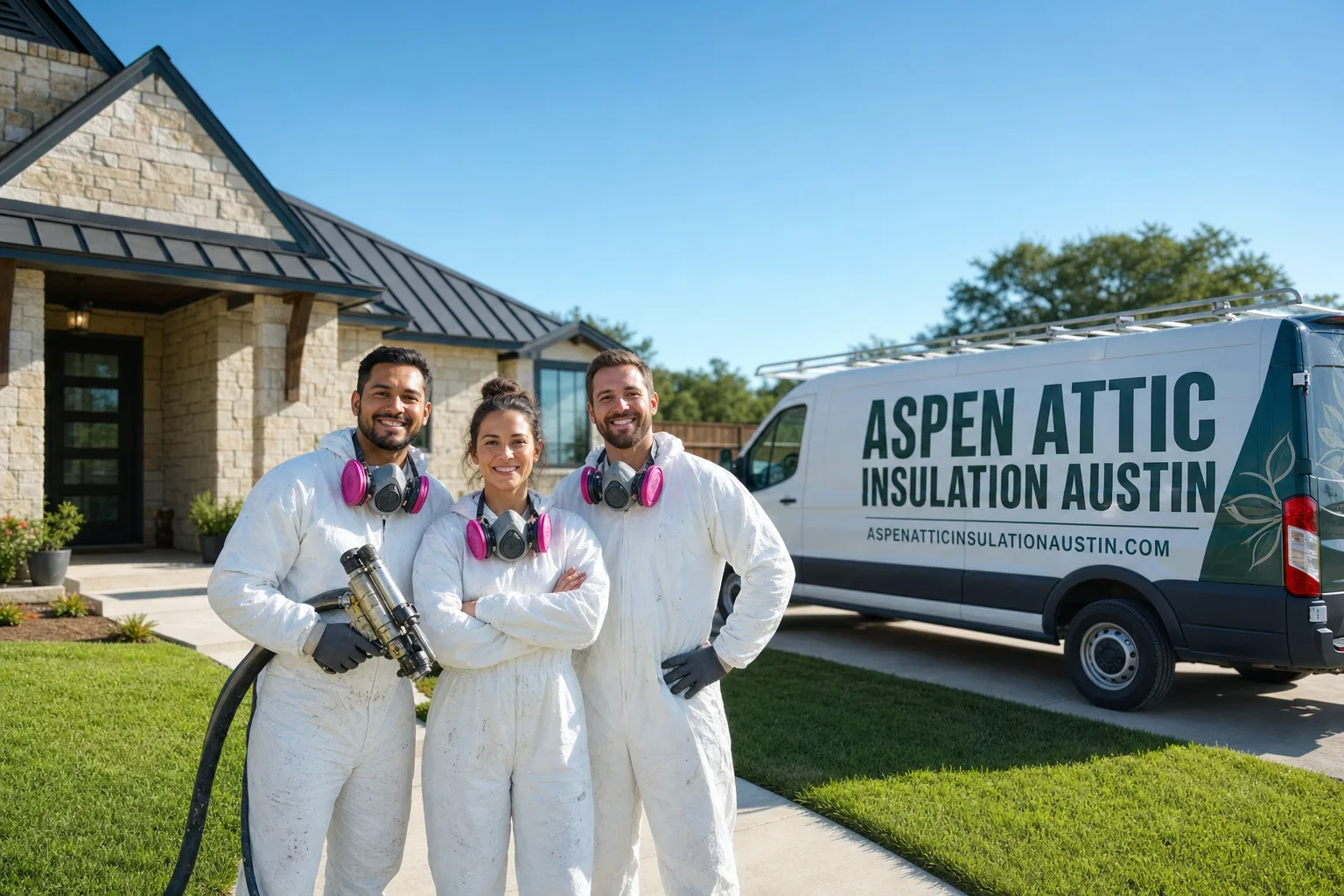
Every step follows what we call the Threshold Standard. Our technicians are background-checked and identity-verified, and they arrive in a clean marked uniform with a photo ID badge. Before anyone knocks on your door, you’ll have their name and photo in your hand. If someone else shows up, the visit is free and we make it right. That’s a promise we’ve kept since 2002, and it’s part of why homeowners with young kids and people who are home alone during the day choose us in the first place.
Materials Used for Attic Air Sealing in Austin
Air sealing isn’t a one-product job. Different gaps need different materials, and the right choice depends on gap size, location, and what’s surrounding it. Here’s what we use and why.
- Single-component spray foam (gun foam). Best for small gaps and cracks up to about an inch: around electrical boxes, wire penetrations, plumbing vents. It’s the workhorse of the sealing trade.
- Two-component closed-cell foam. The right choice for larger gaps and areas where you need an air and vapor seal, like open top plates in humid climates. Austin’s humidity makes closed-cell foam worth the extra cost on certain bypasses.
- Rigid foam board. Used for larger openings like attic hatch covers, knee wall access doors, and whole-house fan housings. Cut to fit, sealed around the perimeter with gun foam.
- Fire-rated recessed light covers. For non-IC-rated can lights, these enclosures maintain the required fire safety clearance while stopping air movement. They’re an absolute must in Austin homes built before IC-rated cans became standard.
- Weatherstripping and latch hardware. For attic hatches and pull-down stair assemblies. A hatch gasket alone won’t do the job; the hatch needs mechanical compression to hold the seal.
- Aluminum tape and mastic. For sealing duct boots and plenum connections where they meet the attic floor or ceiling. Air sealing your attic while leaving duct leaks is like patching a tire with the valve open.
Aspen Attic Insulation Austin sources from eight industry brands (Owens Corning, Johns Manville, Knauf, Rockwool, CertainTeed, Icynene, Demilec, and GreenFiber), and our techs match the material to the specific need. A knee wall in a Tarrytown two-story doesn’t get the same product as a top plate in a Round Rock ranch. The right product goes in, not just the available one.
One Word of Caution
Attic air sealing involves working in a confined, hot space with fiberglass and foam products. Single-component foam gives off isocyanate vapors during application, and improper ventilation while spraying in a tight attic can cause respiratory irritation. This is a professional’s job. We don’t recommend homeowners crawl into a 130-degree attic with a can of foam and start sealing their own top plates. The safety equipment includes a proper respirator, eye protection, and gloves, plus the common sense to know when an attic is too hot to work in. If you want to understand the process better before you spend the money, call us. We’ll walk you through what we found in your specific attic.
FAQs – Attic Air Sealing Cost in Austin
How much is air sealing per square foot in Austin?
In the Austin market, attic air sealing typically runs $0.50 to $1.25 per square foot of home size, depending on attic complexity, penetration count, and insulation conditions. A 2,000 square foot home at $1.00 per square foot lands at $2,000, which matches the typical mid-range Austin quote. Homes with difficult access or heavy penetration density land at the top of the range. For an exact number on your home, call (325) 246-2929 and we’ll write you a free estimate.
Is it cheaper to seal the attic myself?
Material-wise, a homeowner can buy foam cans, weatherstripping, and light covers for $150 to $400 at any Austin hardware store. The problem is that a partial DIY job only cuts out the easy leaks and leaves the hard ones, which are the ones that actually matter. And working in a hot, fiberglass-filled attic with spray foam chemicals carries real health and safety risks. The cost difference isn’t worth the missed penetrations.
How long does attic air sealing take in Austin?
Most Austin homes take one full day for a complete sealing job, with two-story homes or heavily penetrated attics stretching to two days. A partial job (hatch only, or a handful of recessed lights) can be done in two to three hours. Schedule in spring or fall for the fastest appointments and best attic working conditions.
Does attic air sealing really lower electric bills in Austin?
Yes, and the math is easy to check. Austin homeowners with a 2,000 square foot house and summer bills of $250 to $350 a month can typically expect a 10 to 20 percent reduction in cooling costs after a full air seal. That’s $300 to $700 per year in savings. Results are best when sealing is paired with proper blown-in insulation, because the two work as a system.
Can you come air seal my attic today?
We answer our phones 24/7 with a live person, and we’ll get you scheduled as fast as our calendar allows. Same-day or next-day appointments are available depending on season and workload, especially in fall and winter. Call (325) 246-2929 and we’ll check availability for your zip code right then.
Does attic air sealing qualify for rebates in Austin?
Austin Energy weatherization rebates have ranged from $200 to $600 in recent program years, but availability changes. Your best move is to call Austin Energy and ask what’s active, then call us at (325) 246-2929 for a written quote. We’ll help you understand what you’re eligible for, and we’ll never write a number into your estimate that we can’t source.
Why Austin Homeowners Choose Aspen Attic Insulation
Here’s what we know after two decades of attic work in Central Texas: homeowners don’t just want the lowest price. They want to know who is coming to their home and what the job will actually cost. You already have the cost answer. Now you get the who.
When you schedule attic air sealing with Aspen Attic Insulation Austin, you’ll get the technician’s name and photo before the visit. That person will be background-checked and identity-verified, and they’ll show you a photo ID badge when you open the door. They’ll be in a clean marked uniform. They’ll know your attic type before they arrive because we already talked through it on the phone. There is no ambiguity here, and we like it that way.
Our written price comes before any work starts, and it doesn’t change. Our 365-Day Done Right Promise covers every repair for a full year in writing, covering labor and materials. If a repair fails within that year, we return for free and make it right. That’s the second visit guarantee, also in writing. We put our names on the line because the work should hold up.
Aspen Attic Insulation Austin is part of the Threshold Group family, founded in 2002. Each location is independently owned and operated and operates to the Threshold Verified standard. That’s the name behind the background checks, the photo ID protocol, and the clean uniform expectation. Garrett Sloane runs this location, and he holds every tech to the standard he’d want if it were his own house on the line.
Garrett’s view is straightforward: if you can’t show the homeowner who you are before you show up, you haven’t earned the right to come inside. It’s an old-school standard in a modern trade, and it’s the reason our repeat business and referral rate in Austin is what it is.
Get Your Written Attic Air Sealing Estimate Today
You now know what attic air sealing costs in Austin, what moves the number up and down, and what the work actually involves. The next step is a quick attic assessment and a written price in your hands. We answer the phone 24/7 with a live person, every time. Call (325) 246-2929 and we’ll schedule a walkthrough, listen to what’s happening in your house, and put a number on paper before any work begins. No pressure, no surprises, no strangers at your door. Just a sealed attic and lower summer bills.
Pricing reflects the Austin market as of 2026. Aspen Attic Insulation Austin offers free estimates – call (325) 246-2929.
Written by Garrett Sloane, Owner at Aspen Attic Insulation Austin, serving Austin since 2002.
What Our Customers Say
"Blown in cellulose up to R-49 in the attic. Tech badged in at the door and measured the depth with a ruler before and after. Upstairs bedrooms stopped being an oven."
- Fran T."Quiet crew and a neat attic. Rooms stay even now."
- Jill K."Honest assessment. Told me the walls were fine and the attic was the problem. Saved me money."
- Ed M.